

Follow the mantra
Across key destinations around the world, particularly those at the forefront of overtourism, an important shift is taking place, with Destination Marketing Organisations (DMOs) evolving into Destination Management Organisations. This is more than a change in business model, it’s a change in purpose in terms of mandate, accountability and governance. It entails not just promoting a place but looking after it for generations to come, even going beyond stewardship to regeneration so that tourism creates positive impacts and benefits that far outweigh the costs which are mitigated and eliminated.
Yet the change is not wholesale, often constrained by legacy governance approaches, inflexible budgets and antiquated tourism regulation.
It’s time to throw off the shackles and follow the mantra from destination marketing to management for the future wellbeing of local communities, tourism businesses and ultimately the visitor experience.
Time to take a leaf out of the book of front-runners such as Amsterdam, Copenhagen and New Zealand, each embracing different elements of destination stewardship from putting residents front and centre to governance.
Reading the signals
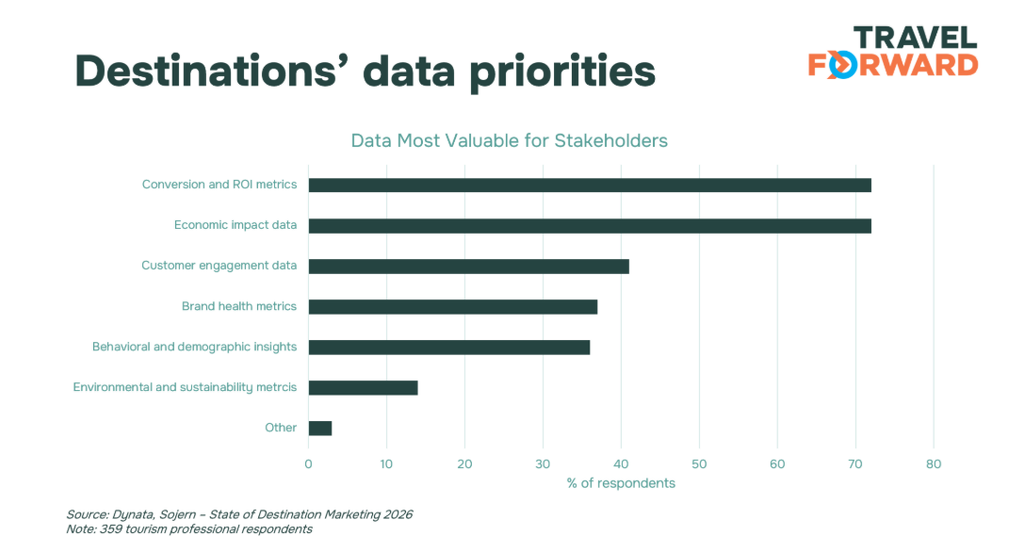
The most valuable data for destination stakeholders are economic impact data and conversion/ROI metrics, sitting neck and neck at 72% each, according to Sojern’s State of Destination Marketing, in partnership with Dynata that surveyed 350 destination marketers world-wide.
It is a good sign that economic impact data is up there with conversion/ROI, however, this encapsulates economic value in terms of tourism spending and jobs. It doesn’t include equity, i.e. how much of that money stays locally and benefits the local community.
Sadly, the priority given to sustainability and environmental metrics is lacking at only 14%. This is surprising considering the climate emergency, with increasing numbers of extreme weather events and wildfires happening at the destination level. For any DMO, that stat should serve as a wake-up call for the inaction and complacency at the heart of the matter.
Changing traveller behaviour requires a change in approach
In Europe, inbound demand is strong at 5.3% for 2026, compared to the world average at 1.9%, held back by geopolitical conflicts especially in the Middle East, according to forecasts from Tourism Economics’ Global Travel Service data. In times of war, intra-regional demand tends to be strong as consumers stay closer to home. Due to affordability concerns, regions like Central/Eastern Europe are outperforming other regions world-wide, offering high value for money appeal. 80% of European destinations experienced volume growth over summer 2026 compared with the previous year, according to the European Travel Commission from TourMIS. Lesser established destinations like Malta, Slovakia, Ireland, Poland, Montenegro and Romania recorded double digit arrivals growth YTD 2026.
European Travel Commission (ETC) sentiment data supports the shift in travel demand to lesser well-known places, with 54% wishing to travel to a less popular or remote destination over Oct 2026-Mar 2027 for their upcoming trips (split 44%/10% respectively). That is not to say that the heydays of France, Spain, Italy and Greece are over, but that demand is diversifying and spreading out to more places especially in Europe. Emerging and smaller destinations need to act now to embrace destination management before destination pressures begin to manifest themselves. Waiting for overtourism pressures is the wrong move and will only lead to double the pain.
Yet volume demand is only one side of the story. There are signs that value growth is weaker for lower cost destinations. This is an alarm bell for emerging destinations, hit by rising inflationary pressures, lack of affordability and subsequently shrinking disposable incomes.
For example, Malta experienced stronger volume 18.1% than value growth 15.6% due to shortened stays. On the other hand, Greece enjoyed stronger value of 12% than volume growth (8.6%), boosted by increased non-EU visitors who tend to spend longer and have a higher spend per trip than average. (Source: TourMIS/Haver Analytics/National Statistics, year to date 2026; the period varies by destination, January to July for Greece.) Other contributing factors for Greece’s strong value performance may well include expanding its season and moving into higher spending segments like wellness and adventure.
The essential role of marketing but not at the expense of stewardship
Marketing will always have a role. In the age of AI, the choice of channels to be present on is dizzying, where 88% have invested in paid social and 68% in search engine optimisation (Source: Sojern). Brand USA alone plans to spend USD165 million on marketing in fiscal year 2027, even after its federal funding was cut, according to Skift, which illustrates the sheer power of marketing.
However, despite its continuing financial clout, marketing needs to be part of the wider, holistic view of destination stewardship so that push and pull levers are not out of sync and that local communities can feel that there is control over carrying capacity, without the risk of breaching unacceptable limits.
It’s very challenging to flex tourism demand. Once flight connectivity is in place the floodgates are open, bringing risks to destinations that have not adequately planned for an increase in visitors.
Destination capacity and resilience can take years to build but can be undermined by a single misguided or over-ambitious move in less than a season
Learning the lessons from when the genie is out of the bottle
Tourism brings often unaccounted for costs and negative impacts to destinations, such as housing shortages, lack of community capacity, infrastructure costs, low paid seasonal work (see Travel Forward’s Destinations at Risk the Invisible Burden of Tourism for more on these risks). To avoid the pitfalls, it is a smart move to embrace the destination management mantra, connecting the dots between economic value, growth opportunities and resident benefits. Understanding economic leakage, where revenue leaves the local community or doesn’t even reach it, is fundamental to success. This starts with mapping local SMEs and regional chains vs international chains to spot where revenue can be kept locally and a more equitable model developed.
This is all whilst delivering the most truly unique, local and authentic travel experience for visitors, as without that, there will be no sustainable success for destinations.
Economic, environmental, social and cultural management go hand in hand for the destinations of the future.
What destinations and operators can do now
Start by getting the remit of your DMO broadened from marketing to management, through discussions with the ministry or government. A clear mandate gives your DMO the authority to manage the impact of tourism on the destination. . Then bring residents in early, because they are usually the last to know or be consulted. This engagement may not be easy t, but it isn’t impossible . Measure what matters to residents: take a lead from Bhutan’s book and track wellbeing, or at least resident sentiment and attitudes to tourism, alongside arrivals and spend. Add economic leakage to your measurements, taking a sector-wide approach across all SMEs and operators. Finally, ask tour operators to review their carbon footprint and the equity they leave in destinations. Travel Forward’s Creating Equitable Destinations research sets out 40 mechanisms to help get started.
Marketing creates demand. Management takes responsibility for its consequences. Stewardship ensures the destination thrives for generations to come, combining a long-term view with a tactical, agile approach


